I’m Shivani, a Senior Data Scientist who writes about building with AI, product thinking, and the occasional experiment on myself.
If you’ve been anywhere near the tech world lately, you’ve heard “agentic AI” thrown around until it loses meaning. I was one of those people nodding along while feeling quietly overwhelmed. So I decided to stop reading about it and build something with it instead.
It had to be something I actually cared about.
Not a generic todo app. Not another chatbot.
If there’s one app that genuinely makes me happy, it’s the Starbucks app. I barely spend time on it. However, when I open it, order my drink, and watch those stars land in my account, something lights up. And when I finally get to redeem them? That little moment of “I earned this” is disproportionately satisfying for what it is.
That feeling is behavioral economics in action. I realized that if Starbucks can make me feel that way about a latte, then I could create the same loop for my own life. Not streaks. Not habit trackers that guilt you when you miss a day. Stars. Real rewards. A system that feels like a game you actually want to play.
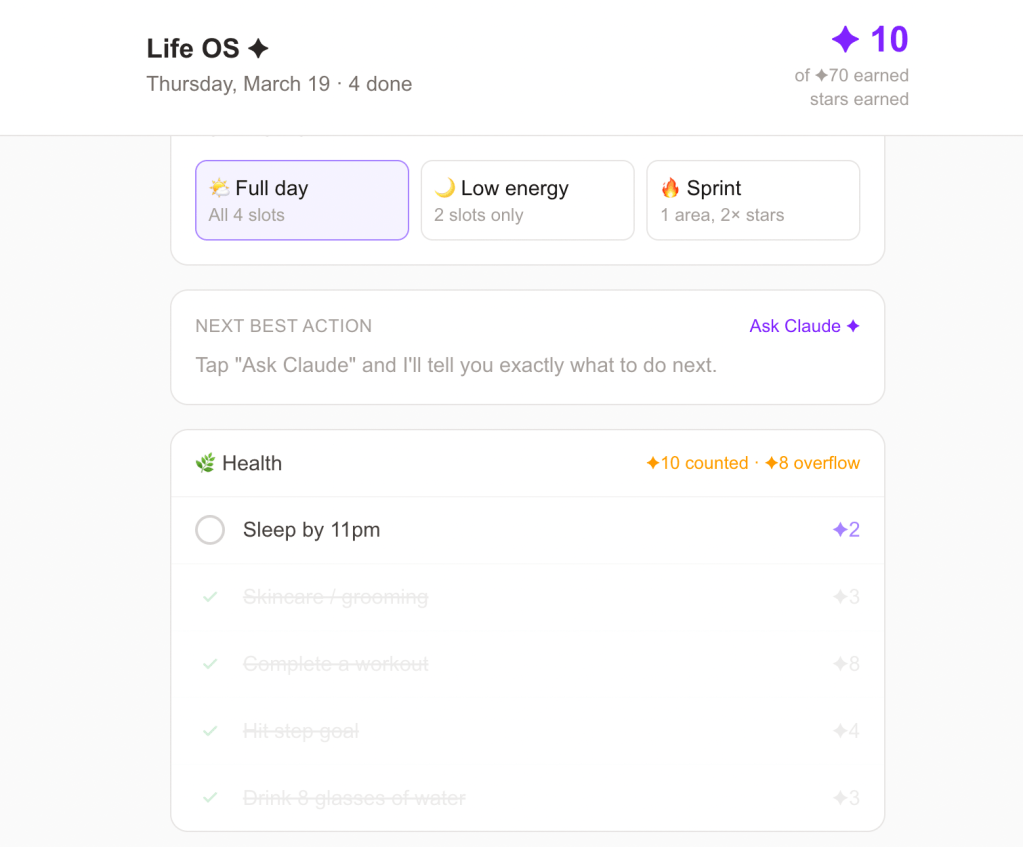
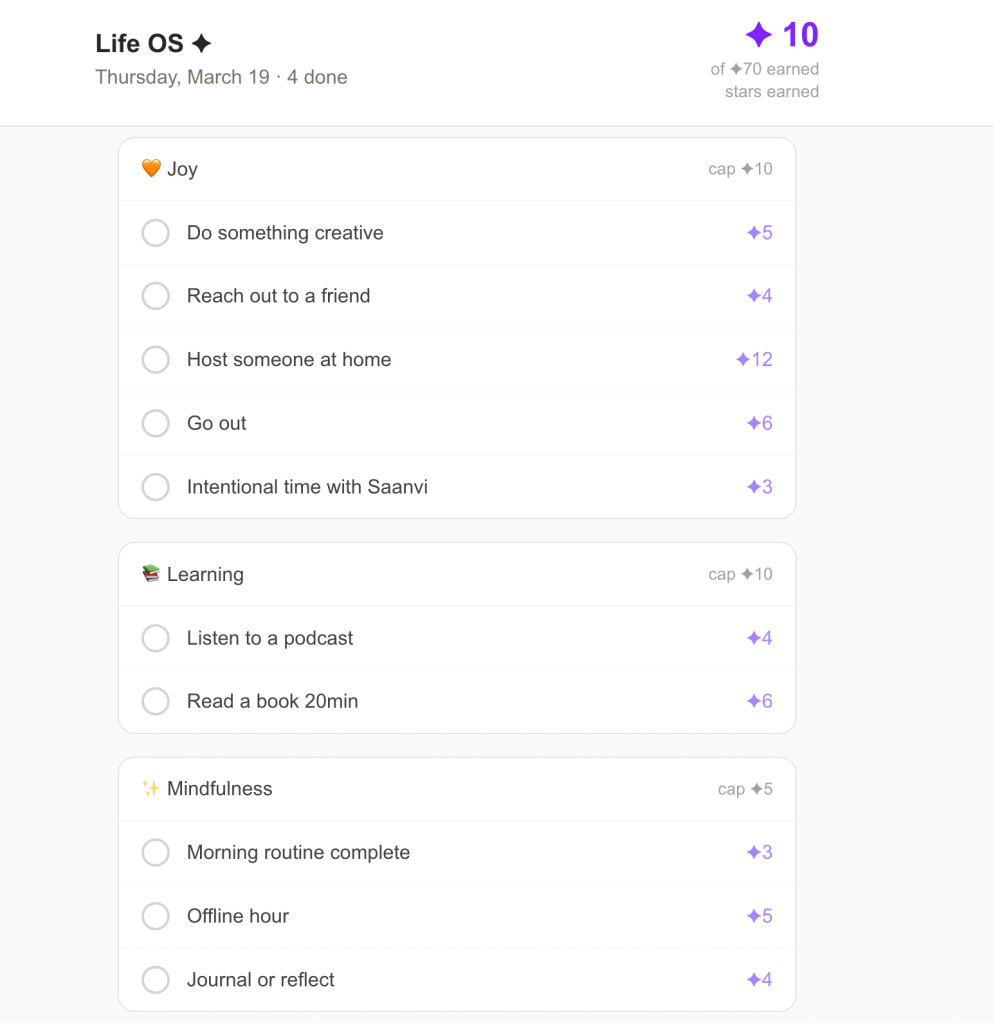
I divided life into six areas: Health, Work, Upskilling Prep, Mindfulness, and Joy & Connection. Each area had tasks. Each task had stars. Complete the task, earn the stars. Simple.
My baseline assumption: 100 stars should feel like a great day.
Then I did the math.
Health → 60–80 stars possibleWork → 30–70 stars possibleUpskilling prep → 60–90 stars possibleJoy & Connection → 25–40 stars possibleMindfulness → 25–50 stars possibleTotal possible → 200–300+ stars a day
A coffee reward costing 100 stars becomes automatic. You hit it before lunch. By Wednesday you have enough for the “experience” tier. The stars stop feeling special . And when stars stop feeling special, the whole system collapses. That’s the Starbucks effect breaking down. Earning stars on the Starbucks app isn’t easy. That’s the point.
But inflation wasn’t even the worst problem I found.
I realized the system could reward fake productivity. You could avoid the hard, meaningful work entirely and stack easy tasks instead:
Drink water → 15 starsRead 20 min → 25 stars Listen podcast → 15 starsTotal → 55 stars, zero real progress
It feels productive. It isn’t. The system was accidentally designed to let you game yourself.
The fix required rethinking the whole architecture. Instead of asking ,”How many stars should this task earn?” , I started from the other end: “how often do I want to redeem a small reward, and what should earning that feel like?” Then I worked backwards.
Design from rewards down, not tasks up.
I also capped how many tasks count toward stars per day, weighted difficulty over activity, and made the daily maximum slightly out of reach, so a perfect day feels genuinely earned, not automatic.
Building this taught me something I couldn’t have learned by reading about product design.
When you are both the designer and the user, every decision becomes personal. There’s no “target persona” . You know exactly what will make you open the app at 9pm when you’re exhausted, and what will make you delete it.
That clarity is brutal and useful at the same time.
A few things I now understand differently:
Behavioral economics isn’t abstract theory. It’s the difference between a system you use and one you abandon. Positive reinforcement only works if the reward feels earned. Over-reward and the dopamine hit disappears. Under-reward and you stop trying. The sweet spot is stars that are slightly out of reach, just enough to feel possible, never quite automatic.
Design for your worst days, not your best ones. I built three day modes into the app.
Full day, Low energy, and Sprint.
The most important one is Low Energy. On hard days, two completed tasks still counts. No guilt. A system that only works when you’re feeling good isn’t a system , it’s a fair-weather friend.
MVP scoping is a skill. The first version of this app has one job: tap a task, earn stars, feel good. No login, no social features, no complex dashboards. Just the core loop working. Everything else is next week’s problem.
I also added a Claude-powered agentic layer that reads your day, what you’ve done, what time it is, what mode you’re in , and suggests the single best next action. But that’s a whole other post.
I’m building this in public.
Next post: what makes an AI system actually agentic, and why the context you give it matters more than the prompt.
If you’re building something similar or have thoughts on reward design, I’d love to hear from you.
Follow along at notesfromshivani.com/technology or on LinkedIn.
More product thinking + building in public
If this was useful, there’s more where it came from.
 Notes From Shivani
Leave a comment