
Tag: self-discovery

  • Things That Know Me

    Things That Know Me

    In the hour before the light, and long after the storm.


    Lately I’ve been thinking about things that truly know me.

    Not the people who claim to.

    Not the ones who say my name like they are announcing a verdict.

    This led me to ask myself, Who knows you?

    These are the things that have witnessed my light and my shadows.

    The cup that remembers how I like my coffee.

    The unwritten journal that waits for the version of me I aspire to become.

    The window that watches me think.

    This is an apothecary of those things.
    An inventory of objects that have memorized me,

    my scent, the songs I hum, the way I breathe when noone is looking.


    My pillow knows how I cry when I turn away,
    and how I tuck my feet in when the world has been too much.
    It smells of lavender oil and forgotten love stories.


    The ikea mug by the sink, knows the calm before the storm.

    It knows the part of me that follows new year resolutions

    and forgotten confessions.

    It knows I dance a little brighter when noone is looking.

    The Apple Music playlist titled Drive in Style knows every version of me:
    The girl who stopped believing in signs.
    The woman who is unbreakable.
    The mother who now sings along, trying to hit every note,
    because a toddler in the backseat thinks I light up the sun.

    My kitchen window knows how I wait,
    especially when it rains.
    It has seen me be patient as the water boils or the cake rises,
    and at a loss for words when I don’t pause between writing angry texts and deleting them.
    It has watched me laugh, lips stained with saffron and joy.
    It knows how the 6:00 AM light touches me like devotion.

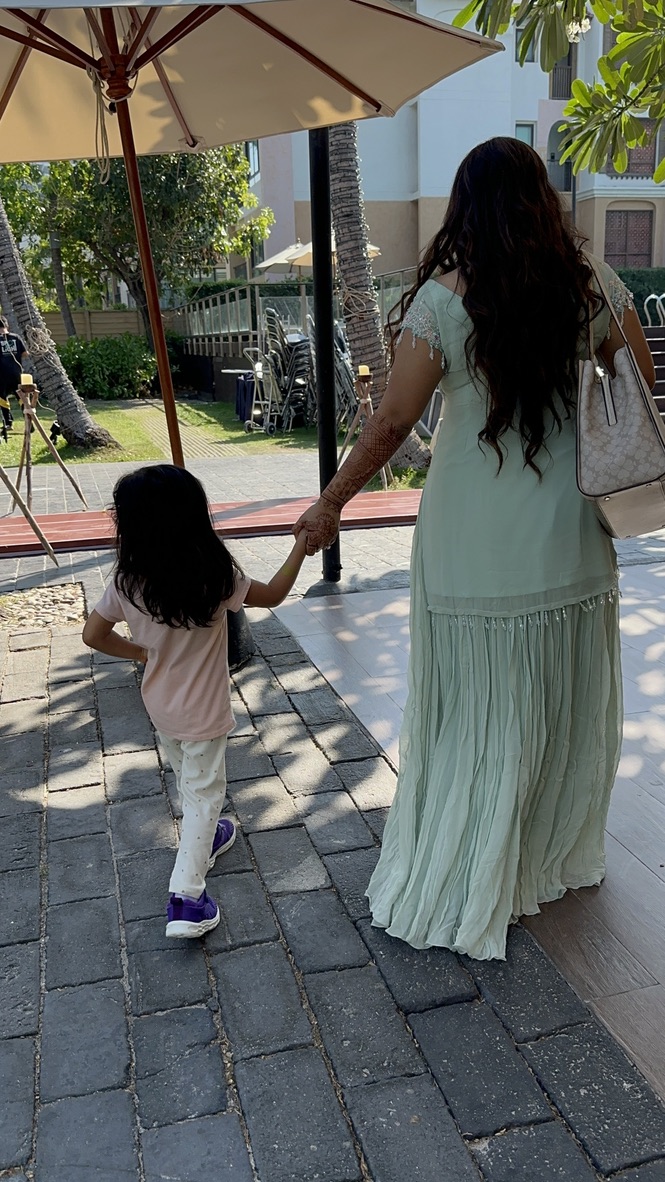
    My daughter’s blanket knows how I sometimes hold it even when she’s not there.
    It knows the shape of my wait,
    folded into its corners and stitched into sleep.

    The mirror in the corner of my house knows I look into it when no one is around.
    It has seen me try on outfits that no longer fit, earrings I’m never going to wear.
    It knows that sometimes I stop just to check if my eyes still read like poems.

    My mother’s rolling pin knows I never get the circle right.
    But I try anyway.
    And it understands,
    sometimes love is lopsided, but love comes in different shapes.

    My cracked phone case knows I scroll through memories like it’s real-time.

    My reading glasses know the myths I collect like facts.
    About women who turn into flames, into sky, into time.
    They know how I long to turn into something, too.

    My worn-out socks know the map of the house I’ve built with love.
    Every tear knows a version of me that bloomed.

    The drawer full of perfume samples knows the women I try to become.

    Some Days I choose cinnamon and somedays Jasmine. I spray them on like spells, soft yet powerful.

    My Dad’s scarf knows exactly how I hold it when I need to feel safe in the world.

    The bathroom window at 6:17 AM knows how I love to shower in the dark, before the day arrives, when the sky is still indigo and house is asleep. The tree outside moves slowly like it’s reaching for me, like it remembers me from another life and finally found me.

    My drafts folder knows nights I fed words instead of myself. It’s full of half-named feelings and half-baked thoughts and it accepts them as they are without a need for me to complete them. 

    Read more reflections like this

    If this reflection spoke to something quiet inside you, you might like what I’ve written here, too.

  • Beyond Rituals: Reclaiming Shakti

    Beyond Rituals: Reclaiming Shakti

    Reclaiming Shakti

    On the quite power within us, beyond rituals

    There’s a moment in every woman’s life where she begins to question, what tradition asks of her and what she wants to keep. This post is a personal reclaiming. It is not rooted in rage. It is not against the rituals, but beyond them.

    Navratri celebrates Shakti, the powerful force behind creation, preservation, and destruction. For nine days, we perform rituals to honor the feminine energy and worship the Goddess in her many forms. But there’s a contradiction in this festival that we often ignore. We pray to the goddess, yet how do we treat the women and girls around us, the real living goddesses, during the rest of the year? Beyond these nine days of worship, do we truly respect and value them in our daily lives?

    Today, in many places, women are still trapped by old traditions, rudhivadi prathaein that limit their freedom and choices. While they are praised in words, they face oppression in reality. During Navratri, we call little girls “devis,” but how many of them are silenced, held back, and denied their potential? Worship during the festival feels empty if it’s not followed by respect, protection, and equality in daily life.

    If we think about time and space in a more cosmic sense, Navratri is like a pause—a fleeting moment  where we pretend to realign with the divine feminine. But what does it mean if, once that moment is over, we return to the same broken patterns? Time is not linear; it folds back on itself. The energy we create during Navratri spreads into the universe, but so does the energy of our actions throughout the rest of the year. Worshipping the goddess for nine days doesn’t undo the harm women endure for the rest of the year.

    The real celebration of Navratri would be to break free from the chains of outdated, oppressive traditions.

    True praise for Shakti isn’t found in ritual alone, it’s found in how we transform our world to honor her in all forms, in every space, and across all time.

    We cannot keep offering respect in these small windows while ignoring the larger flow. Until we evolve, until we truly honor her by breaking down the systems that oppress women, our prayers remain as hollow as the clay idols we immerse at the festival’s end.

    Navratri is filled with rituals—teekadhaaga, offerings, and chants. We go through these motions, believing that by doing them, we’re connecting with the divine. But have we stopped to question what prayer truly means? 

    To me these are simply a series of rituals we have inherited without understanding the depth behind them. 

    To me, these are just rituals, comfortable gestures that make us feel like we’re doing something, even when nothing changes.

    To me, the ritual has become the end itself, and the essence of prayer is lost in the noise of mantras repeated without thought.

    To me, these symbolisms are supposed to complement the deeper work of meditation, self-awareness, and inner transformation. 

    Prayer, in its purest form is meant to expand us and help us transcend dimensions and travel across the multiverse to its origin, Shakti. And, the rituals, the teeka, the dhaaga, amongst many others, they’re reminders, small tokens to keep us grounded. But they’re meaningless if they don’t come with the real work of reflection and inner growth.

    The problem is, we’ve flipped the order.

    We’ve come to believe that performing the ritual is enough, that by placing a thread on our wrists or offering a flower, we’ve done our part. But true prayer starts within. It’s not about what we do on the outside, but how we evolve on the inside. Rituals are meant to be an addition to meditation, a way to support our spiritual journey, not a shortcut to bypass it.

    We cannot expect to honor Shakti through empty rituals on nine days if we’re not willing to do the deeper work of changing how we live and how we treat the women around us. These nine days of prayer are supposed to be a time of transformation, a reflection of the feminine power that flows through the universe. But until we shift our focus from superficial gestures to meaningful change, we will remain stuck in this cycle of hypocrisy—worshipping goddesses in our temples while neglecting the Shakti that lives in every woman.

    यत्र नार्यस्तु पूज्यन्ते रमन्ते तत्र देवताः

    (Yatra naryastu pujyante ramante tatra devataah) 

    taken from the Manusmriti (Manusmriti 3.56)

    Have you ever quietly rewritten rituals in your life? I’d love to hear what reclaiming looks like for you.

    Read more reflections like this

    If this reflection spoke to something quiet inside you, you might like what I’ve written here, too.