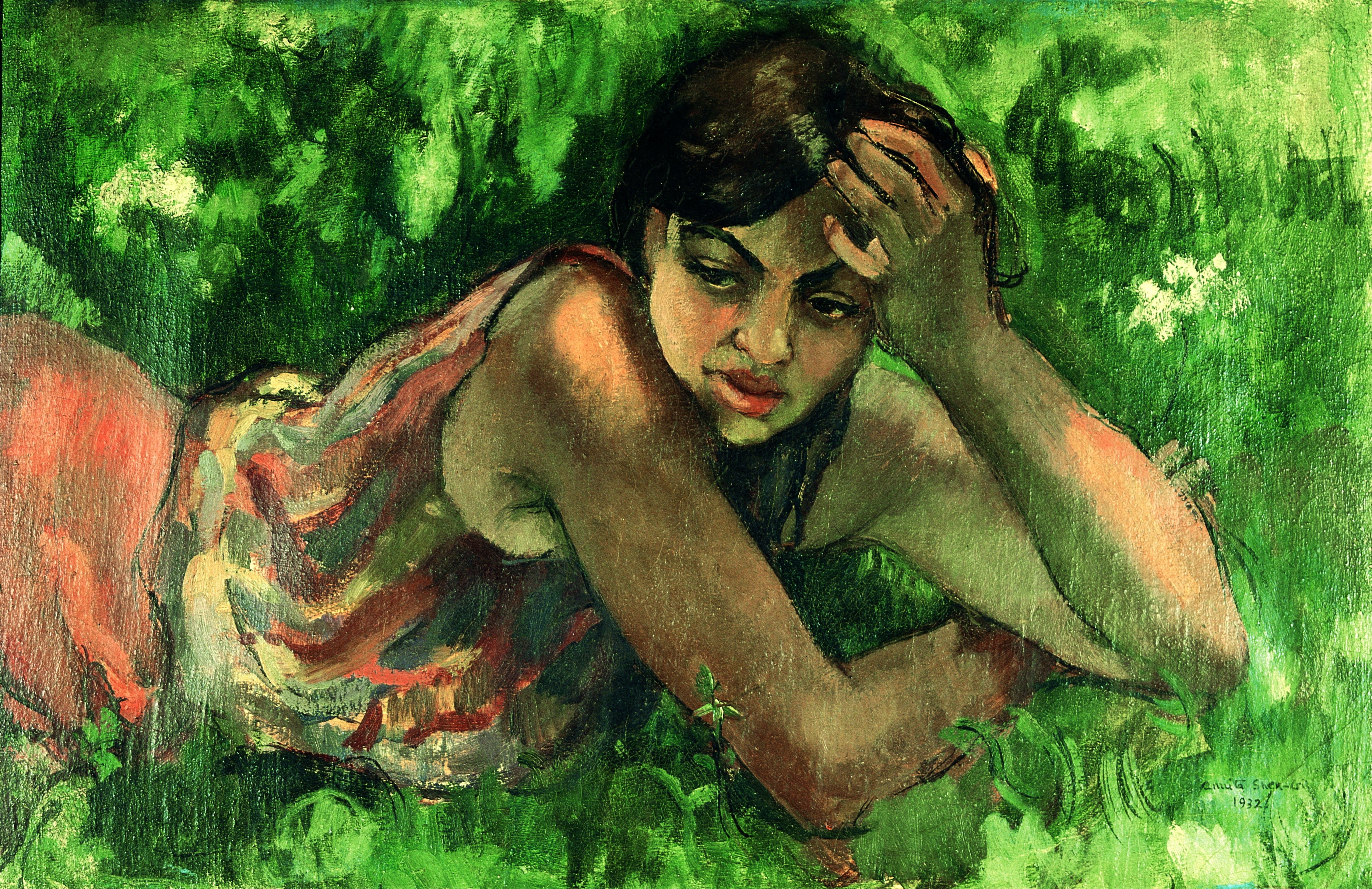

Amrita Sher Gil, Hungarian Gypsy Girl
In India, women start fasting at a young age to get the perfect husband. They pray to Lord Shiv.
One fine day, while eating a bowl of Kellogg’s corn flakes late at night in the small town of Kymore, I asked my Nani, “Why Shiv? Why not Rama? Why not Vishnu?”
We did not end up identifying which god would help me get the perfect husband.
We did end up listing the issues with all the perfect men in Hindu mythology.
Sita cried for Rama. She had to prove herself, her self-worth and finally, she gave up on this world.
Perhaps Rama was a good king. I am simply not convinced he was a good husband.
Lakshmiji, Vishnu made her stay by his feet, took multiple avatars for the betterment of the world while she kept following him. A literal goddess, born many times, only to be rejected. Only to be chosen last.
My critique of Shivji, as a pre-teen, was that he could use a shower and a haircut, to which my Nani laughed hysterically, but also agreed. I did not yet understand what I was looking at.
That was sacred knowledge that I carried young. I believed I had to emulate Sita. That it was my prerogative. But I also learned about Draupadi and Gandhari.
On the surface, these women married and lived for their husbands, but peel the layers of the lotus and every layer reveals something new.
I kept peeling and found myself. Then the knowledge became a burden, until I shed it.
As I grew up, I moved to literatures more authentic to the human experience. And I read, again and again, that a man’s highest virtue is to sacrifice his love.
But I wanted a love that would burn for me.
I don’t need a hero. I chose the villain.
A hero will sacrifice himself, me, and everything I stand for. All for duty, obligation, responsibility, in the name of protecting the realm and the future. A villain will live for me.
The hero will happily see me get destroyed. The villain will shatter the world in ten directions just to be with me.
A hero would test my validity, my purity. The villain will muddy the waters for me.
Books and stories tell us the hero is the ideal.
He makes decisions not out of ego, or so we are told. But really, he cares so much about what his peers will say, whether his elders will approve, whether future generations will be in his debt. He rarely thinks about the woman. And when he does, it is to evaluate her. To measure her worthiness against his standard. We have dressed this up as virtue for centuries. We have not named what it actually is.
Moral authority is its own kind of possession.
Purity culture does not disappear when a man is good. Sometimes it hides deepest inside goodness. The hero believes, quietly, that he has earned the right to judge her. To test her. To decide whether she is worth keeping. He does not chain her with cruelty. He chains her with his approval. And she spends her life trying to deserve it.
Why do I have to be collateral damage for a man’s higher calling?
Am I just a moral checkpoint?
The hero will choose everything else but me. Which means everything is important, but me.
The hero says, “I love you, but I must do what is right.”
The villain says, “You are what is right to me.”
Literary villains did not love cleanly.
They loved with battlefields torn open inside them. The mud mixed with blood like it is holy and pure and ruined all at once.
It reminds me of, Obito from Naruto.
Men screaming in the distance but Obito could barely hear anyone. Just one name ringing in his ear.
Rin.
Not the village. Not the war. Not the future generations who could one day carve out his face. Just Rin. His hands capable of tearing through armies, and he stood there reminiscing her face smiling at him under ordinary sunlight. The unbearable part was not that she died. It was that the world moved on. Somewhere in the distance, shinobi talk about the will of fire. But Obito had crossed the line where morality intersects with grief. Grief rearranged him. People call him villain because he broke the world over one girl. But he had a far more terrifying question for them.
What kind of world demands that I continue without her?
Then there are those whom grief refuses to release.
While the Great Hall is lit with levitating candles and ancient tapestry and the cheerful laughter of wizards, Severus Snape stands decked in black, almost like he wants to merge into the stone walls in secrecy. His love lived inside him like a pulse. Not boastful or declarative. Every corridor must have haunted him. Her laugh etched into his memory. Her eyes passed down to the boy who looked like someone he despised. His love did not choose him. He never got to be chosen. He just kept showing up anyway.
I am not talking about the man who believes he owns a woman.
The hero, ironically, is the one who acts like he owns her, because he believes he has the right to judge her.
At least the villain is honest with his afflictions.
What I am talking about has no clean name. It is not villain. It is not hero. It is fierce prioritization.
Loved without emotional bureaucracy. Someone who does not make her feel negotiable.
If you have not felt every cell of your body compelling you to be there for someone, not out of duty, but out of a love so consuming it reorganizes you, you have not yet felt what it means to be alive.
What Shiva Knew
My grandmother named me Shivani. The voice of Shiva, some say that is Parvati.
I do not think I fully understand him yet. But I know this: he knew he was incomplete without her. He knew he was birthed from her energy. That knowledge, that acceptance, was what separated him from the other two in the trinity.
He was covered in ash. He danced in grief. He destroyed and created in the same breath because he felt an electrifying, undying love for Shakthi in all her forms. He wanted nothing, and when he lost her, he lost himself. The only reason to return was to be with her again. He did not sacrifice her. He raised her. He made her strive for greatness.
But.
Sati did not die in a war. She burned alive in her father’s fire to defend a man who loved her. His grief was real. His devotion re-organised the cosmos. He wandered the earth carrying her body until the gods had to intervene.
And still. She burned.
Parvati earned him through years of tapasya.
She starved herself. She stilled herself. She proved herself.
Only then did he open his eyes.
Even the god who understood devotion required her to demonstrate her worth first.
She must suffer before she is seen. She must burn before she is chosen.
He was still the best of them. But imperfect, all the way down.
Devotion has always had a cost the woman pays first.
The hero continues taking rebirths, saving worlds, accumulating virtue. Perhaps one day something will finally burn his heart. The villain happily dies knowing he already did.
I pity the hero.
But I am no longer certain I envy Parvati.
Perhaps that is why women keep falling for villains in stories. They do not crave destruction. They are just tired of being the thing noble men know how to lose.
And perhaps that is why so many women live quietly in that gap.
The space between what they know love should feel like, and what they actually live.
They have read the mythology. They know the difference between a love that raises you and a love that simply requires you to keep earning it.
They know.
And knowing is not the same as being free.
If you have ever lived quietly in that gap, you are not alone. I see you.

